

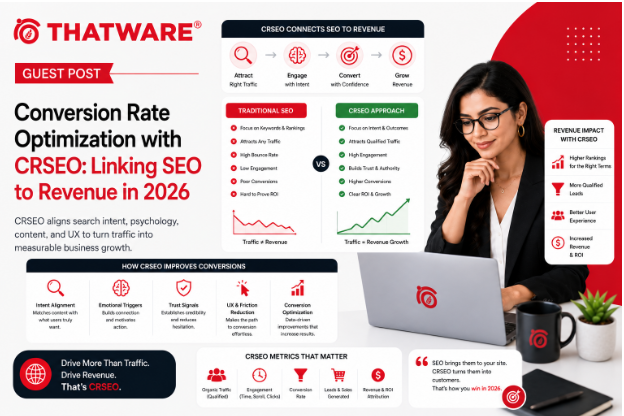
The relationship between SEO and conversion rate optimization has historically been awkward. SEO teams optimize for organic traffic. CRO teams optimize for what happens to that traffic. They report to different people, use different tools, and often work from different assumptions about who their audience is.
CRSEO bridges this gap — not by merging the disciplines but by giving them a shared psychological foundation. When both teams are working from the same understanding of the searcher’s psychological journey, the handoff between SEO and CRO becomes smooth rather than disjointed. And that smoothness shows up directly in revenue.
Where the SEO-CRO Handoff Currently Breaks
The traditional SEO-CRO handoff happens at the landing page. SEO brings the visitor. CRO takes over from there. In theory, this division of labor is efficient. In practice, it creates a problematic psychological gap
The searcher’s psychological state is set before they arrive on the landing page. Their expectations, emotional context, level of trust, and specific anxieties are all shaped by the search experience — the query, the result they clicked, the implicit promise made by the title and meta description. If the CRO team optimizes the landing page without accounting for the psychological state created by the SEO experience, they’re optimizing for the wrong starting point.
Conversion rate optimization with CRSEO creates a unified psychological brief that both teams work from — describing not just the target customer’s demographics and goals but their specific psychological state at the moment of the search query, and how that state should be met at the moment of landing.
Psychological Continuity as a Revenue Lever
The single most impactful CRSEO-informed CRO optimization is usually also the simplest: improving psychological continuity between the search result and the landing page experience.
When the emotional tone, the language, the visual register, and the informational framing of the landing page match what the search result set up, conversion rates typically improve significantly — often without any other changes. The visitor’s brain experiences the arrival as confirmation rather than disappointment, and confirmation triggers continued engagement.
This seems obvious in retrospect. Of course a page that meets you where you are psychologically will convert better than one that surprises or disappoints you. But in practice, most organizations haven’t designed their SEO and landing page experiences to be psychologically continuous because no one was ever explicitly responsible for that continuity.
CRSEO services for conversions establish that responsibility — making psychological continuity an explicit deliverable and measuring it through the behavioral metrics (conversion rate, dwell time, return visits) that reflect whether it’s working.
Measuring the Right Things
The final and perhaps most important piece of linking SEO to revenue through CRSEO is measurement framework alignment.
Traditional SEO measurement: rankings, organic traffic volume, share of voice. Traditional CRO measurement: conversion rate, revenue per visitor, funnel completion.
Neither set alone tells you whether the psychological strategy is working. CRSEO-informed measurement combines both sets with behavioral metrics that reflect the quality of the psychological experience: time on page, scroll depth, return visit rate, content engagement rate, and specifically the conversion rate from organic traffic (not from all traffic — from the specific traffic driven by SEO).
When these metrics improve together, you know the psychological strategy is working end to end — from the search query to the conversion, with a human being at the center of every decision.
That’s the promise of CRSEO. And in 2026, it’s increasingly the baseline expectation for SEO that actually moves revenue.
New Comments